
Assisted Teleconsultation
Documentation on assisted teleconsultation workflow, appointment scheduling from facility agenda, and integration with Rofim platform
Assisted teleconsultation is similar to a standard TC, however, it is a healthcare professional who takes the appointment and who will initiate the appointment with the patient. The patient does not receive an appointment notification or connection link.
In terms of workflow, the specificity of this type of appointment is having to convey 2 healthcare professionals who will perform the TC appointment together.
Appointment Scheduling on the Facility Agenda
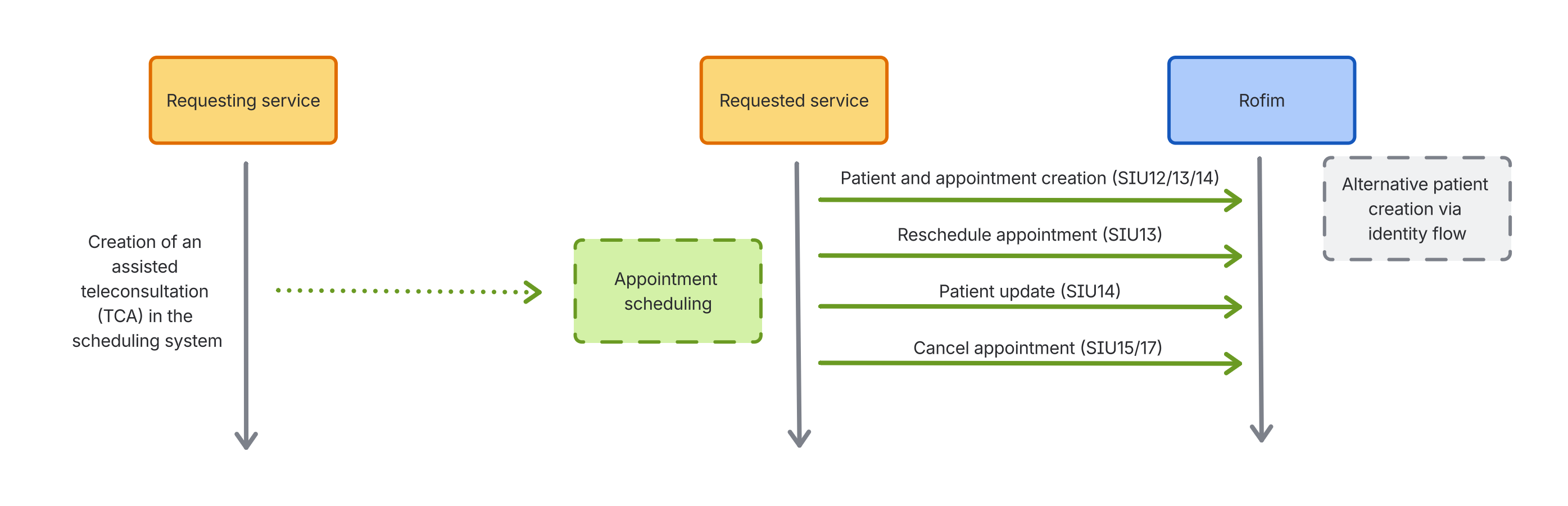
In this case, the appointment is taken from the facility's agenda. This information is sent to Rofim which schedules the appointment in the solution and notifies the users.
| Data | Value |
|---|---|
| Supported format | HL7 2.5 to HL7 2.7 |
| Supported messages (input) |
|
| Message type | POST |
| API link | base_url/tca/siu |
This interface allows the integration of appointments and patients in Rofim. It is also possible to modify the schedule or cancel an appointment.
When anSIU 12message is received for an unknown patient, they are automatically created. Thus, it is not necessary to set up animsflow for TC appointment management and patient creation.
Changing the doctor or service in an already scheduled appointment is not possible. The appointment must be cancelled and then rescheduled.
Patient Demographics Data
Fields not described in this section must conform to the definition provided in the Patient Data / ims flow.
Visit Data
Fields not described in this section must conform to the definition provided in the Visit Data flow.
Appointment Data
The table below details the important data for appointment scheduling:
| Data | Field | Format | Required | Comment |
|---|---|---|---|---|
| Doctor Identifier (RPPS) | AIP.3.1 | String | Cond | Doctor performing the TC appointment. Value of AIP.3.1 if the field AIP.3.13='RPPS'. This field is mandatory if AIL.3.9 is absent. |
| Department or Service | AIL.3.9 | String | Cond | Service that will perform the TC appointments. This field is mandatory if the doctor identifier is absent. |
| Department or Service requesting the appointment | AIL.3.4 | String | Yes | Service requesting the TC. This is the Rofim network ID. This field is mandatory. |
| Appointment Identifier | SCH.2.1 | String | Yes | Unique appointment identifier on the hospital side. This field must be used in subsequent calls to identify appointments. |
| Appointment start date | SCH.11.4 | Date/Time | Yes | Date and time of the appointment in HL7 Time Stamp format. When the time zone is not specified, the time zone is considered to be UTC. The appointment date must be in the future. |
| Appointment reason | AIS.3.1 | String | No | |
| Patient IEP | PV1.19.1 | String | No | The stay number can be updated later via an SIU13 or SIU14 message. This data is useful for billing. |
| RPPS or Adeli of the healthcare professional requesting the appointment | PV1.8.1 | String | Yes | Value of PV1.8.1 if the field PV1.8.13='RPPS'. This field is mandatory. |
When the fieldAIL.3.9is present, then the appointment is created on the corresponding service (and not for a doctor), thus, all the doctors of the service can then perform the appointment with the patient.
Message Examples
TODOTODOTODOTODOAppointment Scheduling on Rofim
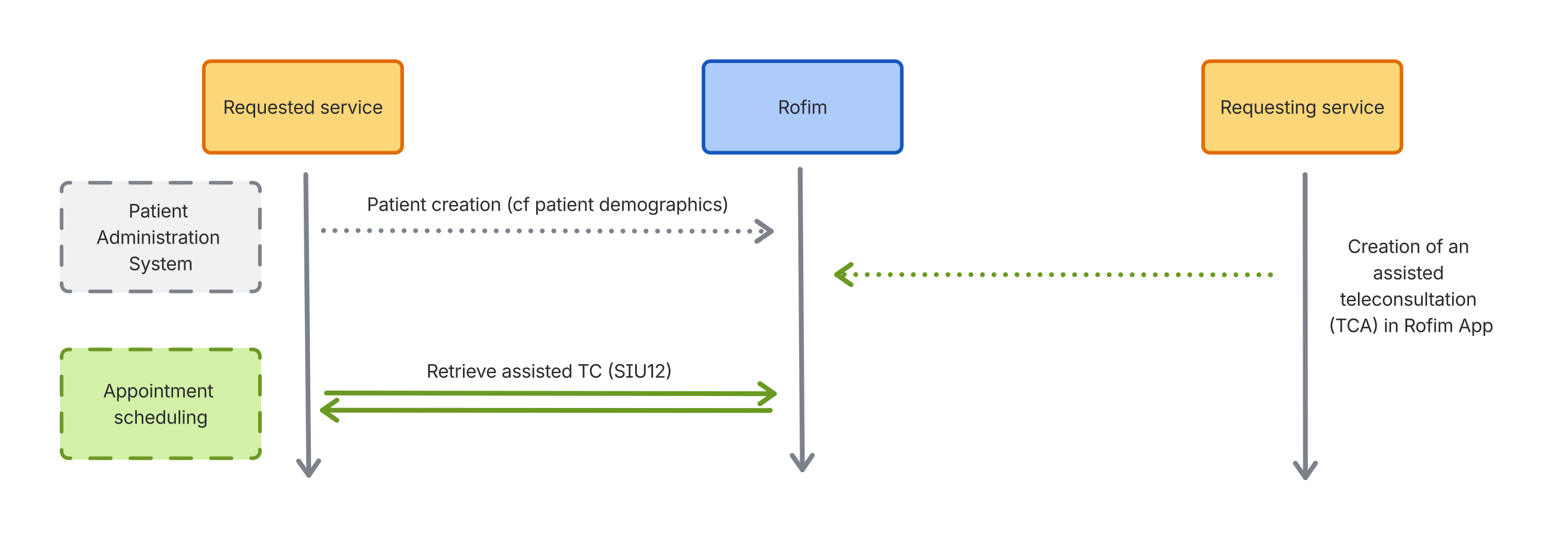
In this case the appointment is taken and confirmed by the parties on Rofim. It is possible to send the appointment information back down to the EHR/Agenda of the facilities of the healthcare professionals concerned by the appointment:
- To the facility of the healthcare professional who requests the appointment
- To the facility of the healthcare professional or Network requested for the appointment. In this case, the patient and their
IPPare probably unknown. It will be necessary to implement the appropriate business logic to be able to integrate appointments on unknown patients.
Updated 6 months ago