
Teleexpertise/Referrals
Teleexpertise/Referrals
Rofim enables complete interoperability of the TE/referral lifecycle with the HIS (Hospital Information System) or Practice Management Software, whether your organization is the requesting or requested party. From a workflow perspective, it's possible to distinguish two types of TE/referrals:
- Outgoing TE/Referrals: When TE/referrals are performed within the facility and sent externally.
- Incoming TE/Referrals: When the facility is addressed from outside (by the community or by another facility, for example).
TE/Referrals are "conveyed" through SIU flows, which allows transporting the patient's identity, as well as a specific reason for the TE/referral and the necessary IPP (Patient Identifier) and IEP (Stay Identifier) for billing and document archiving workflows.
The final objective of implementing these flows is:
- automation of TE/referral billing
- automation of archiving TE/referral reports in patient records
Outgoing TE/Referrals
In the context of outgoing TE/referrals, implementing an IMS flow will help avoid double entry of patient information and find patients via their IPP.
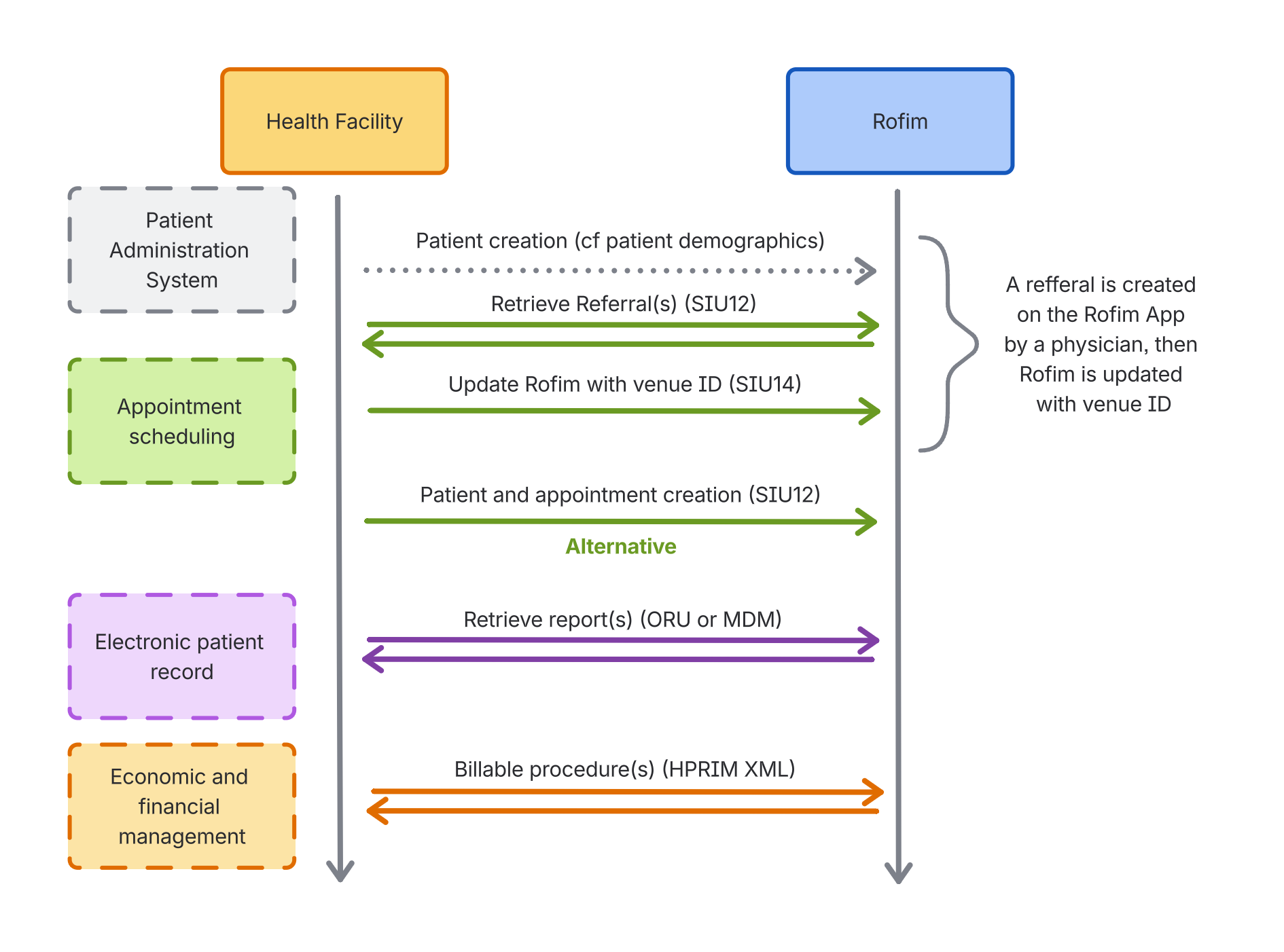
The objective of the following appointment flows (S12 and S14) will be to retrieve the IEP of the stay concerning the TE/referral. The logic is as follows:
- After the TE/referral is created by a physician from the facility, an
S12message is sent to the facility. This message serves as a 'vehicle' for the TE/referral (via a specific reason). It contains the patient concerned by the TE/referral. - The facility then generates a stay number / venue ID.
- The facility sends back an appointment update message (
S14) in which the stay/venue is present.
Retrieving Created TE/Referrals
This flow allows retrieving TE/referrals created via an S12 message for the purpose of the facility generating an IEP.
| Data | Value |
|---|---|
| Supported format | HL7 2.7 |
| Supported messages (outgoing) | SIU 12 |
| Message type | GET |
| API link | base_url/te/created |
TE/Referrals are provided in an XML file containing all SIU 12 messages encoded in base 64. The format of the XML file is described below:
<message>
  <content>SIU12 N°1 encoded in B64</content>
  <content>SIU12 N°2 encoded in B64</content>
  <content>SIU12 N°3 encoded in B64</content>
  ...
</message>
Important Data
| Data | Field | Format | Required | Comment |
|---|---|---|---|---|
| Unique identifier of the TE/referral | SCH.2.1 | String (24 char) | Yes | Unique ID of the TE/referral to use in subsequents S14 messages |
| Namespace of the TE/referral ID | SCH.2.2 | String | Yes | Set to ROFIM |
| Patient identifier | PID.3.1 | String | Yes | Patient IPP as provided by the facility in IMS flows, field PID.3.4 will then take the value ETAB and field PID.3.5 will be PI |
| |-- Assigning Authority | PID.3.4 | String | Yes | For IPP: set to ETAB |
| |-- ID Type | PID.3.5 | String | Yes | For IPP: set to PI |
| Social security number | PID.3.1 | String | Yes | Patient NIR. In this case, field PID.3.4 will then start with the value ASIP-SANTE-NIR |
| Requesting physician identifier (RPPS) | PV1.7.1 | String | Yes | RPPS of the requesting physician. Field PV1.7.13 then takes the value RPPS |
| Appointment reason | AIS.3.1 | String | Yes | Always set to TE_OUT |
Message Examples
<?xml version="1.0" encoding="UTF-8"?>
<message>
  <content>

  </content>
  <content>

  </content>
</message>
<?xml version="1.0" encoding="UTF-8"?>
<message/>Updating Patient ID (IPP) and Venue ID (IEP)
Following the generation of the Venue ID IEP and/or Patient IDIPP, the facility must update the TE/referral via sending an S14 message.
Important Data
Fields not described in this section must conform to the definition provided in the patient / ims data flow.
| Data | Field | Format | Required | Comment |
|---|---|---|---|---|
| Unique identifier of the TE/referral | SCH.2.1 | String (24 char) | Yes | Unique ID of the TE/referral, as set by Rofim in the S12 message |
| Patient identifier | PID.3.1 | String | Yes | Patient IPP (possibly modified), when field PID.3.5 equals PI |
| Stay identifier | PV1.19.1 | String | Yes | IEP or stay identifier. Data necessary for the billing flow. |
| Requesting department's functional unit | PV1.3.1 | String | No | Requesting department's functional unit. Data necessary for the billing flow. |
Message Examples
Patient demographics data
Fields not described in this section must follow the definitions provided in the Patient data / ims flow.
Create TE/Referrals
This flow allows to create TE/referrals via an S12 message.
| Data | Value |
|---|---|
| Supported format | HL7 2.5 toHL7 2.7 |
| Supported messages (outgoing) | SIU 12 |
| Message type | POST |
| API link | base_url/te/created |
This interface injects referrals/TE and patients into Rofim.
When anSIU 12message is received for an unknown patient, the patient record is created automatically. There is therefore no need to implement animsflow to handle referrals appointments and patient creation.
You cannot change the physician for an already scheduled appointment. Cancel the appointment and create a new one instead.
Important Data
| Data | Field | Format | Required | Comment |
|---|---|---|---|---|
| Appointment ID | SCH.2.1 | String | No | Hospital-side unique appointment identifier. Use this value in subsequent calls to refer to the appointment. |
| Patient identifier | PID.3.1 | String | Yes | Patient IPP as provided by the facility in IMS flows, field PID.3.4 will then take the value ETAB and field PID.3.5 will be PI |
| Requesting physician identifier (RPPS) | PV1.7.1 | String | Conditional | RPPS of the requesting physician. Field PV1.7.13 then takes the value RPPS |
| Requesting Department or service | PV1.3.1 | String | Conditional | Requesting department in charge of referral. Required if the physician identifier is missing. |
| Requested physician identifier (RPPS) | AIP.3.1 | String | Conditional | RPPS of the requested physician. Field AIP.3.13 then takes the value RPPS |
| Requested Department or service | AIL.3.9 | String | Conditional | Requested department in charge of referral. Required if the physician identifier is missing. |
| Title | SCH.6.1 | String | Yes | |
| Description | SCH.6.2 | String | Yes |
If Requested physician and Requested Department not provided, a default network will be assigned and the Referral Encounter (TE) will be set to draft status. The physician must then log in to Rofim to complete the referral process.
Message Examples
MSH|^~\&|ROFIMTEST|ROFIMTEST|ROFIMTEST|ROFIMTEST|1778602176||SIU^S12^SIU_S12|1778602176|P|2.5|||||FR|8859/15|FRA
SCH|RDV2026051217786021762|||||ActeTETEST^Acte de téléexpertise entrante de TEST|||15|Min|^^^20260512223000^20260512224500|||||||||10200819980^Antoine^Dupont^^^^^^^ASIP-SANTE-PS&1.2.250.1.71.4.2.1&ISO^^^RPPS|||||PLANNED
PID|||2026033117749648104^^^MCK&1.2.250.1.211.10.200.1&ISO^PI~162125628843005^^^ASIP-SANTE-INS-NIR&1.2.250.1.213.1.4.8&ISO^INS||NOMNQUATRE^PRENOMNQUATRE^TVGHVGHJD^^^^L~NOMUQUATRE^PRENOMUQUATRE^TVGHVGHJD^^^^D||19000404000000|M|||264 rue Grignan^XXXXXX^MARSEILLE^^13004^FRA^H~^^Paris^^^UNK^C~^^Paris^^^FRA^BDL^^||0600000004^PRN^PH~0600000004^PRN^PH~0600000004^PRN^CP~^NET^internet^[email protected]|||W||12345678765^^^MCK|||||Paris|||FRA||||N||VALI
PV1||O|||||10200819980^DR^DR^^^^^^^ASIP-SANTE-PS&1.2.250.1.71.4.2.1&ISO^^^RPPS||||||||N||||12345678765|C|07|N|||||||||||||||||||N|||20250328070000|20250328235900
RGS|1
AIS|1||ActeTETEST^Acte de téléexpertise de TEST|20260512223000|0|Min|15|Min
AIL|1||UFRDV|||20260512223000|0|Min|15|Min
AIP|1||^Antoine^Dupont^^^^^^^ASIP-SANTE-PS&1.2.250.1.71.4.2.1&ISO^^^RPPS|||20260512223000|||15|Min
Incoming TE/Referrals
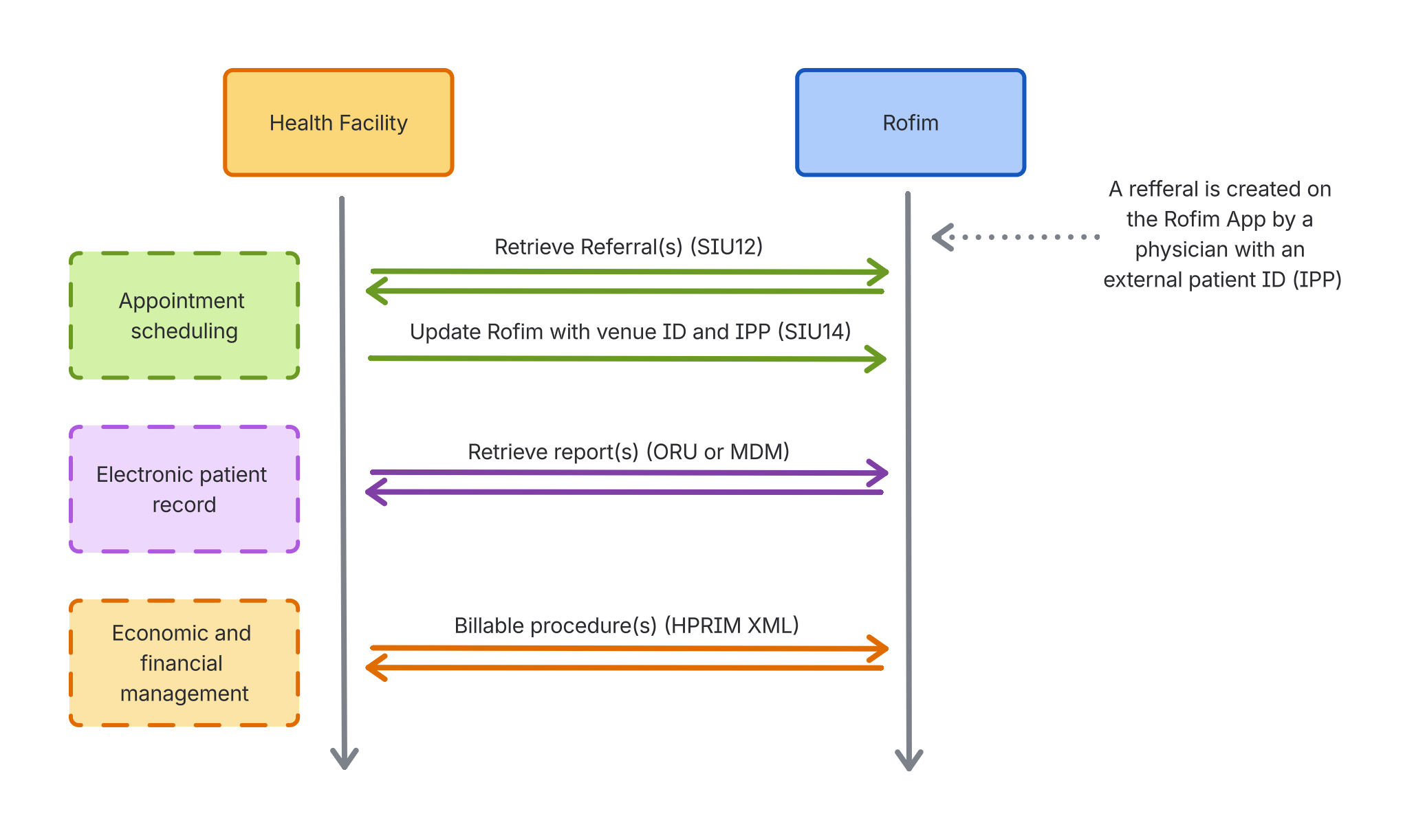
The objective of the following appointment flows (S12 and S14) will be to retrieve the patient's IPP on the hospital side and the IEP of the stay concerning the TE/referral. The logic is as follows:
- After the TE/referral is closed (and the report is written) by a physician from the facility, an
S12message is sent to the facility. This message serves as a 'vehicle' for the TE/referral (via a specific reason). It contains the patient concerned by the TE/referral. - The facility must then match the patient with a patient known to the hospital (via INS or identity management data) or create a temporary patient, the purpose of this creation being to enable billing of the TE/referral act.
- The facility then generates a stay number.
- The facility sends back an appointment update message (
S14) in which theIPPand stay are present.
Admissions Office and Patient Identity ManagementDuring this step, patient identities will be injected into the HIS, it's important to involve the admissions office and patient identity management teams early on these topics that will impact patient creation processes.
Retrieving TE/Referrals Addressed to the Facility
This flow allows retrieving closed TE/referrals (i.e.: a report has been written by a physician from the facility) via an S12 message for the purpose of the facility generating an IPP and an IEP.
| Data | Value |
|---|---|
| Supported format | HL7 2.7 |
| Supported messages (outgoing) | SIU 12 |
| Message type | GET |
| API link | base_url/te/responded |
TE/Referrals are provided in an XML file containing all SIU 12 messages encoded in base 64. The format of the XML file is described below:
<message>
  <content>SIU12 N°1 encoded in B64</content>
  <content>SIU12 N°2 encoded in B64</content>
  <content>SIU12 N°3 encoded in B64</content>
  ...
</message>
Important Data
| Data | Field | Format | Required | Comment |
|---|---|---|---|---|
| Unique identifier of the TE/referral | SCH.2.1 | String (24 char) | Yes | Unique ID of the TE/referral to use in S14 messages |
| Namespace of the TE/referral ID | SCH.2.2 | String | Yes | Set to ROFIM |
| Patient identifier | PID.3.1 | String (24 char) | Yes | Patient IPP as provided by the facility in IMS flows, field PID.3.4 will then take the value ROFIM and field PID.3.5 will be PI |
| |-- Assigning Authority | PID.3.4 | String | Yes | For IPP: set to ROFIM |
| |-- ID Type | PID.3.5 | String | Yes | For IPP: set to PI |
| Social security number | PID.3.1 | String | Yes | Patient NIR. In this case, field PID.3.4 will then start with the value ASIP-SANTE-NIR |
| INS | PID.3.1 | String | Yes | Patient NIR. In this case, field PID.3.4 will then start with the value ASIP-SANTE-INS |
| Requesting physician identifier (RPPS) | PV1.7.1 | String | Conditional | RPPS of the requesting physician. Field PV1.7.13 then takes the value RPPS |
| Requesting Department or service | PV1.3.1 | String | Conditional | Requesting department in charge of referral. Required if the physician identifier is missing. |
| Requested physician identifier (RPPS) | AIP.3.1 | String | Conditional | RPPS of the requested physician. Field AIP.3.13 then takes the value RPPS |
| Requested Department or service | AIL.3.9 | String | Conditional | Requested department in charge of referral. Required if the physician identifier is missing. |
| Appointment reason | AIS.3.1 | String | Yes | Always set to TE_IN |
Message Examples
<?xml version="1.0" encoding="UTF-8"?>
<message>
  <content>

  </content>
  <content>

  </content>
</message>
<?xml version="1.0" encoding="UTF-8"?>
<message/>Updating IPP and IEP
Once the facility has been able to create an identity for the patient, it's necessary to send an S14 message with the updated data important for billing:
IPPIEPUF(Functional Unit)
The format and endpoint of this message is identical to that of the incoming TE/referral, and described here.
Retrieving TE/Referral Reports
| Data | Value |
|---|---|
| Supported format | HL7 2.7 |
| Supported messages (outgoing) | MDM or ORU |
| Message type | GET |
| API link | base_url/te/report/retreive |
Retrieving TE/referral reports is identical for incoming and outgoing TE/referrals. Thus, only one connector needs to be implemented. All available reports added since the last call are provided in the response to this interface.
Reports are provided in an XML file containing all HL7 messages encoded in base 64. The format of the XML file is described below:
<message>
  <content>HL7 ORU or MDM N°1 encoded in B64</content>
  <content>HL7 ORU or MDM N°2 encoded in B64</content>
  <content>HL7 ORU or MDM N°3 encoded in B64</content>
  ...
</message>
The MDM or ORU message contains the report in PDF encapsulated in base 64. The message also contains additional business data allowing easier file management on the Electronic Health Record side. This important data is described below.
Important Data
| Data | Field | Format | Required | Comment |
|---|---|---|---|---|
| Identifier of the physician who submitted the case | PV1.7 | String | Yes | The PV1.7 segment is populated with the name/first name and RPPS of the physician who submitted the case in the multidisciplinary team meeting session. |
| Unique document identifier | TXA.12 | Structure | Yes | TE/Referral reports can be updated and received multiple times by a facility, in case of document update for example. In this context, the TXA.12 field allows identifying a document that would be updated. The field format is as follows:
|
Message Example
<?xml version="1.0" encoding="UTF-8"?>
<message>
  <content>

  </content>
  <content>

  </content>
</message>
<?xml version="1.0" encoding="UTF-8"?>
<message/>Billing
| Data | Value |
|---|---|
| Supported format | HPRIM XML 1.04 or 2.1 |
| Supported messages (outgoing) | HPRIM XML |
| Message type | GET |
| API link | base_url/te/billing/retreive |
This interface allows retrieving performed acts ready to be billed. All new acts performed since the last call are returned by this interface.
Retrieving TE/referral billing files is identical for incoming and outgoing TE/referrals. Thus, only one connector needs to be implemented. Act coding will be different depending on the type of TE/referral:
TE2for incoming TE/referrals on which an opinion has been provided by a physician from the facilityRQDfor an outgoing TE/referral
Limit on the number of reimbursable TE/referralsRegulations limit the number of reimbursements for a patient/requested physician pair to 4 per year. In this case, the act will be coded with this value:
TE2_LIMIT_REACHED
<message>
  <content>HPRIMXML N°1 encoded in B64</content>
  <content>HPRIMXML N°2 encoded in B64</content>
  <content>HPRIMXML N°3 encoded in B64</content>
  ...
</message>
Important Data
Message Example
<?xml version="1.0" encoding="UTF-8"?>
<message>
  <content>
  </content>

  <content>
  </content>

  <content>
  </content>
</message>TODOTODOPatient Matching via INS
In the context of incoming TE/referrals, the ideal operation is to match the patient brought by the community to the hospital via qualified INS. This data will be present in the PID.3.1 field (with PID.3.4 set to ASIP-SANTE-INS). However, field experience shows the following issues:
- A low rate of qualified INS for community patients
- The presence of foreign patients
- The presence of patients without INS
It is therefore necessary to implement, on the facility side, a two-step matching process:
- Based on INS if it is present and qualified
- Based on strict identity management traits
Updated 2 months ago